



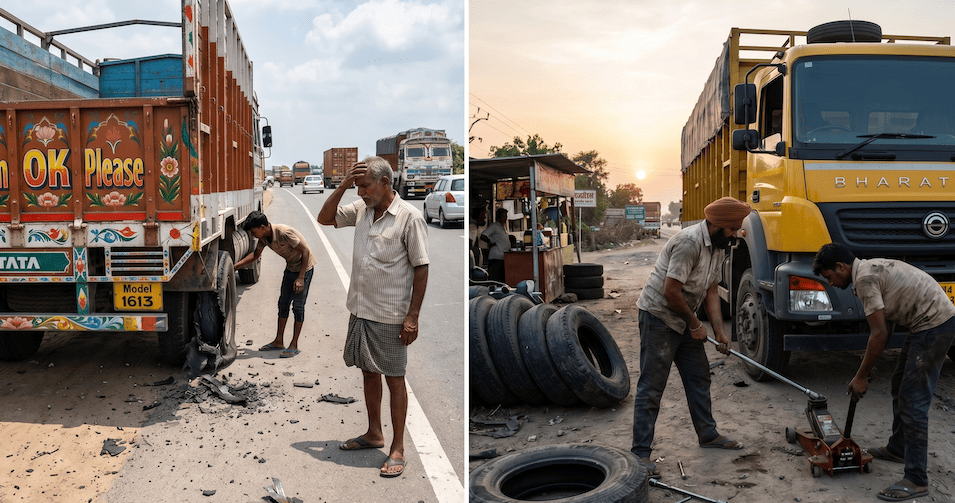
Why Commercial Tyres Fail Early?
Commercial vehicles are the backbone of any logistics or transport operation. But one thing that silently drains fleet budgets and causes dangerous breakdowns is premature tyre failure. The good news? Most of it is completely avoidable.
Here's a straightforward look at why commercial tyres fail before their time — and what you can do about it.
1. Under-Inflation
This is the number one cause of early tyre failure. When a tyre runs below its recommended pressure, the sidewalls flex too much with every rotation. This generates excess heat inside the tyre, which breaks down the rubber and separates its internal layers — long before the tread wears out.
Many drivers do a visual check and assume the tyre looks fine. It often does, right up until it fails.
2. Overloading
Every commercial tyre has a load index — the maximum weight it's designed to carry. When vehicles are loaded beyond this limit, the tyre absorbs stress it was never built for. The heat builds up internally, and the failure often happens hours after the overloaded run, making it hard to connect to the real cause.
3. Road Hazards and Kerb Strikes
Potholes, broken road edges, and kerb impacts cause internal bruising to the tyre's cord structure. This damage is invisible from the outside. The tyre may hold pressure for days or even weeks before the weakened area gives way — sometimes at highway speed.
4. Wheel Misalignment
When axles are misaligned, tyres run at a slight angle to the direction of travel. This scrubs rubber off one shoulder unevenly while the rest of the tread looks normal. Fleets often miss this until a shoulder blowout forces the issue. A routine alignment check every six months can prevent this entirely.
5. No Rotation Schedule
Drive axle tyres wear much faster than trailer tyres. Without regular rotation, the same tyres take constant punishment while others barely wear. This shortens overall tyre life and increases total fleet costs. A simple rotation every 20,000–25,000 km makes a significant difference.
6. Sun, Heat, and Ozone Damage
Vehicles parked outdoors for long periods are exposed to UV radiation and ozone in the air, both of which slowly degrade rubber. Sidewall cracking begins well before tread depth becomes a concern. In India's climate — especially during peak summer — this process is accelerated considerably.
7. Wrong Tyre for the Job
A tyre designed for long highway runs behaves very differently from one built for urban stop-and-go routes. Fitting the wrong specification — wrong load rating, wrong compound, wrong tread pattern — means the tyre is fighting conditions it was never designed for. This alone can cut tyre life by 30 to 50 percent.
What You Can Do
- Check tyre pressures every morning with a calibrated gauge — never rely on visual inspection
- Stick to a rotation schedule based on actual kilometres and axle position
- Get wheel alignment checked every six months or after any major road impact
- Match tyre specifications to your actual route and load profile
- Inspect sidewalls after long runs for bulges, cuts, or cracking
- Store spare tyres indoors, away from direct sunlight and motors that emit ozone
The Bottom Line
Tyres don't fail on the day they blow. They fail weeks earlier — quietly, invisibly — while nobody was paying attention. A little discipline in maintenance and specification goes a long way toward keeping your fleet moving safely and your costs under control.
Need help building a tyre maintenance schedule for your fleet? Get in touch with ATF Tyres.